
Project Overview
This case study demonstrates how tactical search intent mapping and semantic content structuring completely transformed the online visibility of a boutique Women’s Fitness Club. Within 4 months of strategic execution, the website broke through a long-standing traffic plateau, generating more organic traffic in a single week than it had previously in an entire quarter.
Niche: Women’s Fitness Club
Timeline: 4 Months
Core Focus: Female-Centric Long-Tail Keyword Targeting, Local SEO Maps Optimization, Content Gap Liquidation, and Internal Link Silos.
The Challenge
The client operated a premium fitness club tailored exclusively for women, offering personal training, group fitness classes, and postpartum wellness programs. However, their website was structurally stagnant and failed to capture local search market share.
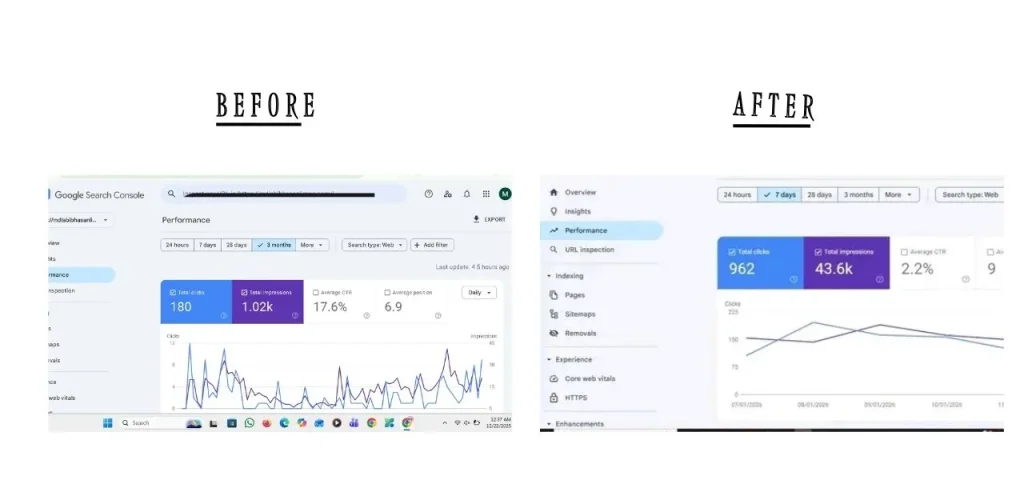
The Historical Baseline (Rolling 3 Months): Over an entire 90-day period prior to the campaign, the website crawled at a negligible 180 total organic clicks and 1.02K impressions.
The Diagnostic Bottleneck: The site lacked topical authority. High-intent search terms like “women’s only gym near me” or “female personal trainer [City Name]” were pointing to generic, unoptimized gallery pages rather than dedicated, conversion-focused landing pages.
The 4-Month Growth Framework
To bypass legacy domain friction and capture high-intent local traffic, I executed a phased, audience-specific SEO playbook:
Month 1: Semantic Niche Architecture & Site Auditing
Silo Structure Creation: Disentangled the site’s flat architecture. Built dedicated, high-converting landing pages for individual services rather than clustering them on a single page. Created optimized URLs for Weight Loss Programs, Strength Training for Women, and Private Female Coaching.
Header Hierarchy Engineering: Optimized headers (H1, H2, H3) using exact-match and LSI (Latent Semantic Indexing) keywords tailored to female search behavior, shifting focus toward community and expert female guidance.
Month 2: Technical SEO & Mobile UX Polish
Mobile-First Loading Fixes: Since over 85% of the target audience’s searches originated from mobile devices, I optimized image payloads (heavy gym/facility photos), deferred unused CSS/JavaScript, and stabilized Cumulative Layout Shift (CLS) for seamless mobile browsing.
Core Web Vitals Audit: Resolved structural bugs and caching configurations to drop page rendering times below the 2-second mark.
Month 3: Local Maps Domination & Schema Ingestion
Localized Entity Optimization: Updated and optimized the Google Business Profile (GBP) and matched it with advanced LocalBusiness and ExercisePlan schema deployment on the website. This established a rock-solid geographic footprint.
Citation Consistency: Streamlined the brand’s Name, Address, and Phone number (NAP) across authoritative regional health and business registries to instantly clear indexing ambiguity.
Month 4: Link Equity Injection & CTR Hyper-Optimization
Regional Backlink Acquisition: Secured high-quality contextual backlinks from localized lifestyle blogs, female wellness platforms, and regional business directories to push organic positions into the top tier.
Meta-Tag Re-engineering: Wrote compelling, click-optimized meta tags featuring conversion hooks (e.g., Free Gym Pass and Expert Female Trainers) to maximize search engine result page interaction.
The Results
The mathematical impact of this 4-month campaign was explosive. By fixing technical roadblocks and matching topical relevance, the domain witnessed a compounding surge in visibility:
Key Takeaway
Generating 962 targeted organic clicks in just 7 days compared to a legacy baseline of 180 clicks over 3 months proves the power of a structured 4-month Local SEO strategy. The club now acquires daily membership inquiries, trial sign-ups, and class bookings completely organically, entirely eliminating their dependence on expensive paid ad spend.
Conclusion
By aligning the website’s technical structural health with user search psychology over 4 months, this female fitness brand secured dominant local visibility. The project stands as a prime example of how targeted semantic architecture can turn a low-exposure local business site into a high-octane customer generation machine